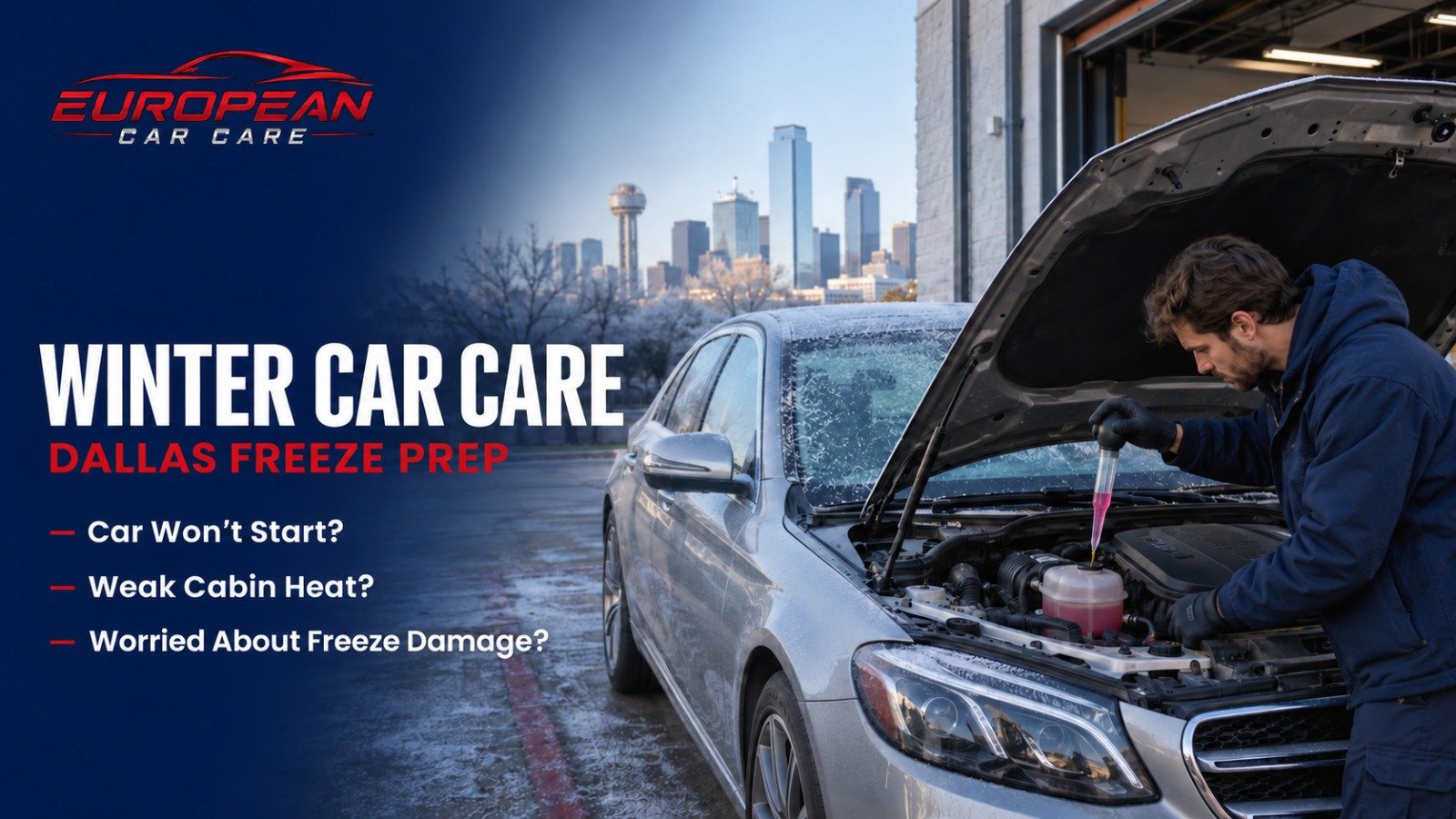
In North Texas, winter rarely eases in with a gentle warning. You can cruise down the Dallas North Tollway in 72°F sunshine on a Tuesday afternoon and wake up Wednesday morning to an Arctic cold front, freezing rain, and black ice across every highway overpass. When the temperature drops 40 degrees overnight, precision-engineered European vehicles feel that sudden shock far more intensely than standard commuter cars. A heat-weakened battery, a hairline crack in a pressurized coolant tank, or trapped moisture inside an air suspension line can turn a crisp morning commute into an unexpected roadside tow.
Taking care of winter car maintenance or getting professional help for your Mercedes-Benz or Range Rover repair in Dallas before the next cold snap hits is the smartest way to protect your vehicle’s performance and avoid preventable repairs. European models rely on tight mechanical tolerances, complex electronic modules, and specialized fluids that respond poorly to last-minute guesswork. Below is a clear, engineering-focused freeze checklist built specifically for Dallas luxury and performance drivers so you can prepare your car properly before freezing weather arrives.
Why Do Sudden Dallas Freezes Trigger Hidden Issues in European Cars?
Thermal Shock on Precision Components
European engines run hotter and under higher cooling-system pressure than most domestic vehicles, which puts heavy stress on under-hood plastics and rubber seals during Texas summers. When a sudden 30°F to 40°F cold front sweeps through the Metroplex, those heat-aged polymer coolant expansion tanks, O-rings, and turbocharger coolant lines contract rapidly. That sudden thermal contraction often splits brittle fittings overnight, leaving a puddle of antifreeze under your car before you even start the engine.
Heavy Electrical Load in Cold Weather
Modern vehicles from BMW, Mercedes-Benz, Audi, Porsche, and Range Rover run dozens of active control modules alongside heated seats, heated steering wheels, rear defrosters, and high-output lighting. A battery that barely survived August heat in Dallas loses a huge share of its cranking power the moment temperatures dip below freezing. Because intelligent battery management systems restrict electrical accessories when voltage drops, a weak battery often triggers a cascade of dashboard warnings before failing to start altogether.
Why Professional Diagnostics Beat Guesswork
Generic code readers used at quick-lube chains only pull basic powertrain fault codes, rather than performing the actual BMW or Mercedes-Benz repairs in Dallas, missing deeper manufacturer-specific alerts stored inside chassis, gateway, and comfort modules. European engineering demands factory-grade diagnostic platforms capable of reading live sensor data, checking battery registration history, and testing electronic thermostats. Pinpointing a failing component accurately before a freeze saves you from paying for trial-and-error part swaps.
The Ultimate European Freeze Checklist for Dallas Drivers
Battery Health and AGM Registration
Most European luxury cars use Absorbent Glass Mat batteries mounted in the trunk or under the cargo floor to power sensitive onboard electronics. A proper winter inspection tests cold cranking amps under load rather than just checking resting voltage. Whenever a battery needs replacement, a European specialist also codes and registers the new unit into the vehicle’s power management computer. Hence, the alternator adjusts its charging curve and prevents premature overcharging.
Coolant Mixture and Cooling System Integrity
European automakers formulate silicate-free, phosphate-free coolants, such as G48 for BMW and Mercedes-Benz or G12 and G13 formulas for Audi and Porsche, to protect aluminum engine blocks and water pump impellers from galvanic corrosion. Technicians test the exact antifreeze-to-water freeze point using a refractometer while pressure-testing the expansion tank, electric water pump, and radiator hoses for seepage. Catching a weeping thermostat housing early prevents sudden overheating or freeze damage during a cold snap.
Cold-Start Synthetic Motor Oil Protection
Twin-turbocharged and direct-injected European engines depend on thin, rapid oil flow during the first few seconds after a cold start to protect timing chain tensioners and turbocharger bearings. Verifying that your crankcase holds fresh, factory-approved full-synthetic motor oil ensures the lubricant stays fluid enough to circulate instantly on a 25°F morning. Old, fuel-diluted oil thickens in cold weather and accelerates top-end wear right when your engine needs protection most.
Air Suspension and Compressor Moisture Check
If you drive a Range Rover, Mercedes-Benz, Porsche Cayenne, or Audi equipped with air ride suspension, cold weather exposes hidden moisture inside the pneumatic system. Over humid Texas months, condensation can collect inside the air compressor dryer or valve block and freeze solid overnight, causing one corner of the vehicle to sag or triggering a suspension fault on the dash. Inspecting air struts, desiccant dryers, and height sensors before freezing rain hits keeps your ride height level and protects the compressor from burning out.
Brake System and Fluid Moisture Testing
Brake fluid is hygroscopic, meaning it naturally absorbs microscopic moisture from the humid North Texas air over time. Even though brake fluid itself does not freeze easily, absorbed water lowers its boiling point and can form ice crystals inside narrow anti-lock braking system valves during hard winter stops. Testing brake fluid moisture levels and inspecting rotor thickness ensures crisp, balanced stopping power when sudden sleet hits Dallas highways.
Tire Tread Depth and Cold PSI Calibration
For every 10°F drop in outside temperature, tire air pressure falls by roughly 1 to 2 pounds per square inch. When Dallas temperatures plunge 35 degrees overnight, all four tires can lose enough pressure to trigger low-pressure warnings and reduce wet-road contact patch right when you need traction most. Calibrating tire pressures to factory door-jamb specs on cold mornings and checking tread depth ensures your tires channel slush and freezing rain away safely.
Wipers, Sub-Zero Washer Fluid, and Cabin Heating
Intense Texas sun bakes rubber wiper blades dry all summer, leaving them streaky and brittle the first time freezing mist hits your windshield. Replacing worn blades, flushing out plain summer water with freeze-resistant washer fluid, and testing the heater core, blend doors, and rear defroster grid guarantees clear visibility when temperatures plummet.
Dallas Winter Driving Hazards: Preparing for Overpasses, Black Ice, and Warning Lights
Navigating Elevated Highways and Bridges
Because cold air circulates both above and below elevated concrete roadways, Dallas bridges and highway flyovers, especially along I-35E, I-635, and the Dallas North Tollway, freeze hours before ground-level streets. Even when surface roads only look damp, elevated ramps can hide invisible sheets of black ice. Properly inflated tires, responsive anti-lock braking, and healthy stability control sensors give your vehicle the split-second reaction needed to stay composed across icy overpasses.
Never Ignore Cold-Weather Dashboard Alerts
When a low coolant symbol, battery discharge message, or air suspension warning pops up during a cold snap, treating it as a harmless weather glitch is a costly mistake. Driving even a few miles with low coolant or a sagging air strut can crack an aluminum cylinder head or burn up an air compressor. Pulling over safely and scheduling an immediate diagnostic scan keeps a minor sensor or seal issue from turning into a major mechanical repair.
Dealership vs. European Specialist: Where Should You Schedule Winter Maintenance?
Brand Specialization
General repair shops work on every type of vehicle under the sun, which often leaves them guessing when faced with complex European engineering. A dedicated European specialist brings over 25 years of hands-on mastery across BMW, Mercedes-Benz, Audi, Porsche, Range Rover, Jaguar, Bentley, Rolls-Royce, Maserati, and Aston Martin. You get the same deep marque-specific knowledge you expect from a franchise dealership, paired with seasoned technicians who understand how these vehicles age in North Texas heat and cold.
Diagnostic Precision
Relying on generic code readers during a winter checkup often leads to trial-and-error part replacements that waste both time and money. Specialized European workshops invest in manufacturer-grade diagnostic tools that communicate directly with every onboard control module, battery management system, and air suspension controller. Pinpointing the exact root cause on the first scan ensures your car is fixed right before freezing weather sets in.
Pricing and Quotes
Franchise dealerships carry massive showroom overhead, and those costs show up directly in steep hourly labor rates and inflated parts markups. An independent European specialist gives you transparent, itemized quotes before any wrench turns, with zero surprise add-ons. Even better, you get honest, fair pricing structured 10% lower than any competitor’s quote so you can winterize your vehicle with complete confidence.
Parts and Repair Warranty
Protecting a luxury or performance vehicle requires high-grade components that meet strict factory tolerances rather than cheap, generic substitutes. A trusted European specialist uses reputable parts engineered for your specific make and backs every repair with a solid 12-month or 12,000-mile warranty. That coverage gives you genuine peace of mind long after the cold front passes.
Convenience and Turnaround Time
Waiting weeks for a dealership service bay or spending half your workday stuck in a lounge makes seasonal maintenance easy to put off. Dedicated European specialists prioritize fast same-day turnarounds on routine winter services and offer complimentary Uber rides within a 5-mile radius while your car is in the shop. Dropping your car off fits smoothly into your schedule instead of disrupting your entire day.
Protect Your European Car Before the Next Cold Front
Scheduling proactive winter maintenance with European Car Care across Dallas, Carrollton, Plano, Frisco, Irving, Addison, and Richardson protects your luxury or performance vehicle against sudden North Texas freezes. Backed by 25+ years of specialized experience with BMW, Mercedes-Benz, Audi, Porsche, Range Rover, and related marques, the shop utilizes factory-grade diagnostics, warranty-backed parts, transparent estimates priced 10% lower than competitors, same-day routine service, and free local rides from their Carrollton location at 2613 Marsh Ln. Drivers can call (214) 483-9900 or request an online text estimate to prepare before the next freeze arrives.
Frequently Asked Questions
How long should I warm up my European car on a freezing Dallas morning?
Modern fuel-injected and turbocharged European engines only need 30 to 60 seconds of idling so oil pressure stabilizes before you drive off gently. Letting your car idle in the driveway for ten minutes actually wastes fuel and warms the engine and transmission far more slowly than driving smoothly at low engine speeds.
Do I need dedicated winter tires in Dallas, or are all-season tires enough?
Because North Texas freezes are usually short and roads stay mostly dry or wet rather than packed with deep snow, high-performance all-season tires with healthy tread work well year-round. However, if your Porsche, BMW M, or Mercedes-AMG rides on summer performance tires, those softer rubber compounds harden below 45°F and lose grip quickly on cold pavement.
Should I wash my car after a Dallas ice storm if TxDOT treats the roads?
Yes, scheduling a wash with an undercarriage rinse after icy weather clears is a smart precaution. Texas road crews spray liquid brine and de-icing chemicals across bridges and highways before a freeze, and rinsing that residue off prevents corrosion on aluminum suspension components, brake lines, and underbody fasteners.
Does parking my car in a garage eliminate the need for a winter inspection?
While garage parking shields your car from overnight frost and freezing rain, your vehicle still faces freezing ambient air, icy bridges, and heavy electrical loads the moment you pull onto the road. A pre-winter inspection still catches weak batteries, aging coolant tanks, and low tire pressures before they leave you stranded away from home.